Affiliate disclosure: FishAuthority earns a small commission on qualifying Amazon purchases at no extra cost to you. Links use our tag twfishauth-20. This never influences our recommendations, we selected these kits based on build quality, included components, long-term hobbyist reliability, and honest value for beginners.
Best Aquarium Starter Kits 2026: 8 Complete Setups for Every Budget
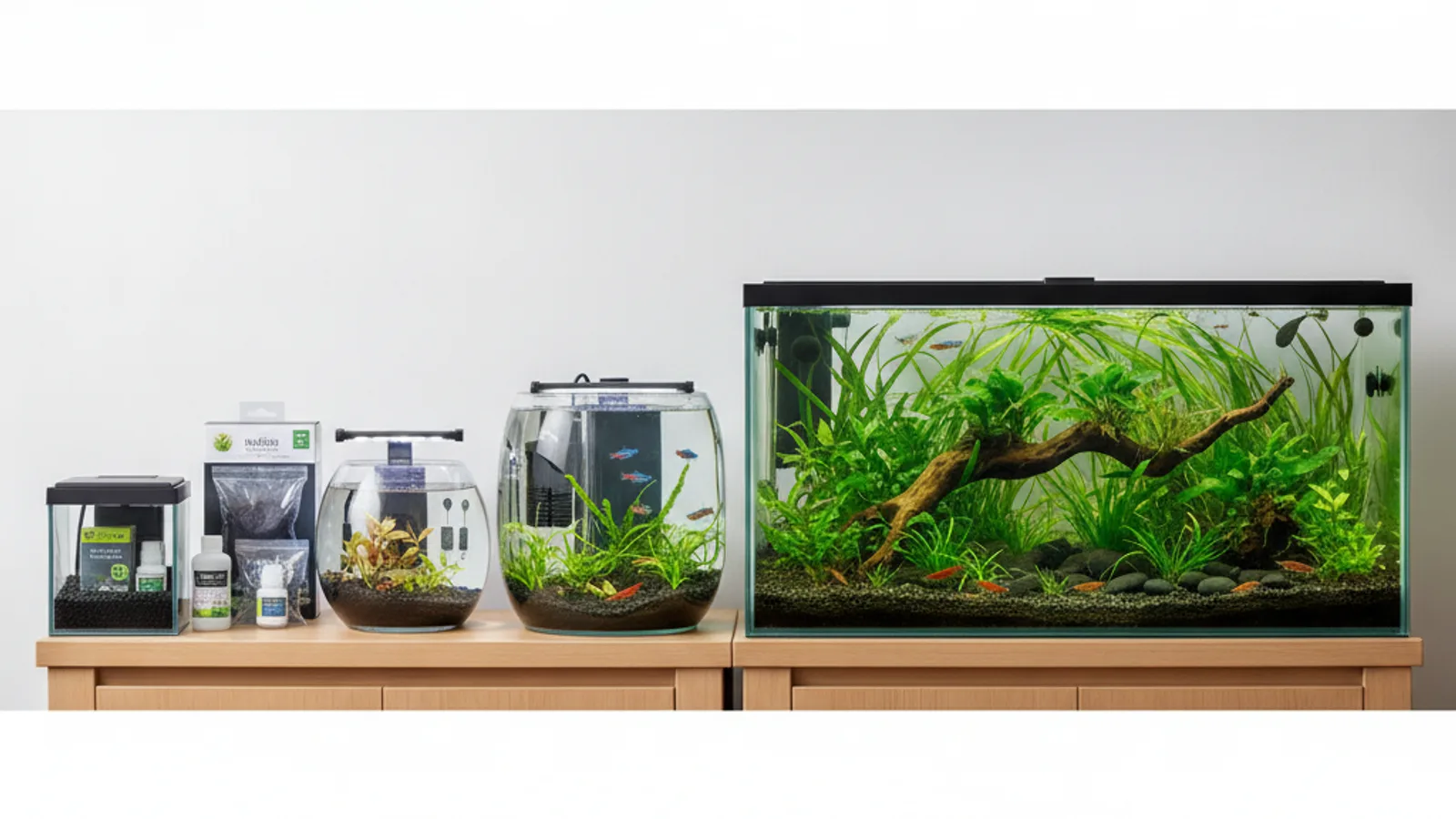
Choosing a starter kit is harder than it looks. Walk into any pet store and you will find 5-gallon "betta in a vase" tanks next to 55-gallon ensembles, with nothing in between explaining which size will kill your fish the fastest or which filter will need replacing within six months. Most beginners buy too small (because the price is low) or too large (because bigger seems better) and end up frustrated either way.
The guides below cut through that. We evaluated starter kits across 8 use cases, from a single betta in a 5-gallon to a full 55-gallon community display, and ranked each pick on what matters: whether the included filter, heater, and light are actually adequate for the tank, and whether the kit gives beginners a real shot at keeping fish alive through the first 90 days.
Not sure what size you need? Jump to the tank size guide below before buying, or use the FishAuthority Stocking Calculator to check if your desired fish list fits a specific tank size.
At a Glance
 Tetra Aquarium, 20 Gallon, Complete Tropical Fish Tank...
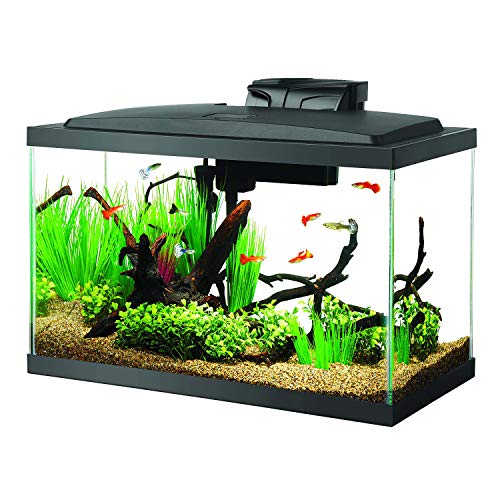 Aqueon Aquarium Fish Tank Starter Kit with LED...
 Fluval SPEC Aquarium Kit, Aquarium with LED Lighting...
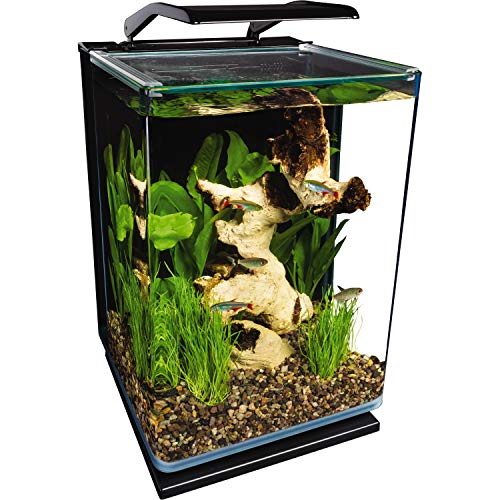 Marineland Portrait Glass LED Aquarium Kit, 5 Gallons,...
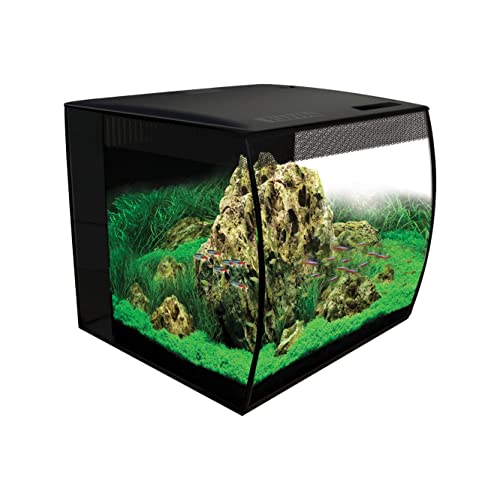 Fluval Flex 57 - 15 Gallon Nano Glass Aquarium Kit
 Aq LED DLX Starter Kit 29
Product images and titles from Amazon. As an Amazon Associate we earn from qualifying purchases.
Quick-Picks Table
| Pick | Kit | Tank Size | Approx. Price | Shop |
|---|---|---|---|---|
| Best Overall | Tetra 20 Gallon Complete Aquarium Kit | 20 gal | ~$75 | Amazon → |
| Best Budget | Aqueon 10-Gallon LED Starter Kit | 10 gal | ~$50 | Amazon → |
| Best for Bettas | Fluval Spec V 5-Gallon | 5 gal | ~$85 | Amazon → |
| Best Nano/Portrait | MarineLand Portrait 5-Gallon | 5 gal | ~$60 | Amazon → |
| Best for Plants | Fluval Flex 15-Gallon | 15 gal | ~$110 | Amazon → |
| Best 29-Gallon | Aqueon 29-Gallon Aquarium Kit | 29 gal | ~$110 | Amazon → |
| Best Premium | Fluval Flex 32.5-Gallon | 32.5 gal | ~$160 | Amazon → |
| Best Large | Aqueon 55-Gallon Aquarium Ensemble | 55 gal | ~$175 | Amazon → |
Tank Size Guide: Which Size Is Right for You?
Tank size is the single most important decision a new fishkeeper makes, and the most commonly wrong one. Smaller is not easier to maintain. Smaller tanks swing through temperature and chemistry changes faster, require more frequent water changes, and leave almost no margin for beginner mistakes like overfeeding.
| Tank Size | Best For | Water Change Frequency | Max Beginner Stock |
|---|---|---|---|
| 5 gallon | 1 betta solo, OR shrimp colony, OR snails | 25–30% twice weekly | 1 betta (do not add tankmates) |
| 10 gallon | 1 betta OR small school (6 neon tetras) + 2 corydoras | 25% weekly | ~10 small fish inches total |
| 20 gallon | Community tank: gouramis, tetras, corydoras, livebearers | 20–25% every 1–2 weeks | 20–25 small fish inches total |
| 29–30 gallon | Same as 20 gal, more schooling room, single cichlid | 20% every 1–2 weeks | 25–30 small fish inches total |
| 40–55 gallon | Full community display, angelfish, larger cichlids | 20% every 2 weeks | 40–55 small fish inches total |
Fish-inch estimates above use a conservative bioload-adjusted stocking rule and assume a cycled tank with a properly sized filter. Use the FishAuthority Stocking Calculator for a more precise stocking plan based on your specific species list.
What a Starter Kit Actually Includes
Before diving into specific products, here is what a decent starter kit includes, and the one critical item every kit leaves out:
| Component | Most Kits Include | What to Upgrade Later |
|---|---|---|
| Tank | Glass tank with frame (most include lid) | N/A, the glass itself is fine |
| Filter | Entry-level HOB sized for the tank | AquaClear 70, Seachem Tidal 75, see our filter guide |
| Heater | Preset or adjustable submersible heater | Cobalt Neo-Therm or Fluval E Series, see our heater guide |
| Lighting | Basic LED hood or strip | Fluval Plant 3.0 for planted tanks |
| Lid/hood | Yes, usually integrated with light | N/A |
| Thermometer | Most kits include a strip or glass stick | Digital stick thermometer for accuracy |
| Water conditioner | Small sample packet | Seachem Prime, far more concentrated, better chemistry |
| Liquid test kit | Never included | Must buy: API Master Test Kit (non-negotiable) |
1. Best Overall: Tetra 20 Gallon Complete Aquarium Kit
~$75 | Best for beginners setting up their first community tank
The Tetra 20-gallon kit is the most universally recommended beginner setup in the hobby, and for good reason. Twenty gallons is the sweet spot: stable enough that temperature and chemistry swings happen slowly (giving you time to diagnose and correct problems before fish die), and large enough to keep a genuine community, a school of 8 neon tetras, a pair of honey gouramis, and a few corydoras, without weekly water changes becoming a burden.
The included Whisper HOB filter is quiet and reliable, rated for up to 20 gallons. The LED hood provides adequate light for low-tech plants (java fern, anubias, hornwort) without driving algae growth. Most kits include a 100W preset heater, thermometer, fish food, and a water conditioner sample to get the tank filled and running the day it arrives. Tetra's parts ecosystem is widely available at pet stores, so replacements are never a hunting expedition.
| Pros | Cons |
|---|---|
| 20-gallon volume gives beginners real margin for error | LED hood is basic, not bright enough for stem plants |
| Whisper filter is quiet; Tetra parts widely available | Preset heater can't be adjusted if you need warmer temps for bettas |
| Complete out-of-the-box, filter, heater, LED, conditioner all included | Kit hood fits the tank only, limits future upgrades to glass tops |
Shop Tetra 20 Gallon on Amazon →
2. Best Budget: Aqueon 10-Gallon LED Starter Kit
~$50 | Best for a first betta tank or small schooling fish on a tight budget
The Aqueon 10-gallon kit is the lowest-cost entry point that still provides a complete, functional setup. It includes the glass tank, an LED hood (white LEDs, adequate light), Aqueon QuietFlow 10 HOB filter, 50W preset heater, net, thermometer, fish food, water conditioner, and a plastic divider card. The QuietFlow 10 is a genuine entry-level HOB, it will keep up with a lightly stocked 10-gallon, though you will want to swap in an AquaClear 20 or 30 as soon as the budget allows.
The main limitation of a 10-gallon is the stocking ceiling. You can keep a betta solo, a school of 6–8 nano tetras (ember tetras, neon tetras) with 2 corydoras, or a colony of cherry shrimp. That's it. Do not try to add a pleco, a cichlid, or a "centerpiece fish", they will crash your water quality before the nitrogen cycle can catch up. If you think you might want more variety within 6 months, buy the Tetra 20 instead.
| Pros | Cons |
|---|---|
| Lowest upfront cost of any complete kit in this guide | 10-gallon stocking ceiling means limited fish variety |
| Aqueon parts (filter cartridges, heater) stocked at most pet stores | QuietFlow 10 filter is entry-level, plan to upgrade |
| Divider card useful if you want to keep two bettas separated | Requires more frequent water changes than 20 gal |
Shop Aqueon 10 Gallon on Amazon →
3. Best for Bettas: Fluval Spec V 5-Gallon
~$85 | Best dedicated betta setup
The Fluval Spec V is the most recommended betta tank by experienced fishkeepers, and it earns that reputation for reasons that matter: the etched glass construction is dramatically more attractive than plastic-hood kits, the hidden back-panel filtration system provides genuinely good 3-stage filtration for a 5-gallon, and the adjustable return nozzle lets you dial down the output to a betta-safe gentle flow. Most 5-gallon filters produce a current strong enough to stress bettas, the Spec V's adjustability solves that without modification.
The 37-LED light (7,500K color temperature) is more than adequate for low-tech plants that bettas enjoy as cover (anubias, java fern, floating plants). Five gallons is still a small tank that demands 25–30% water changes twice weekly and careful feeding discipline, bettas are messy eaters and 5 gallons offers no buffer on ammonia spikes. But if you are committed to a betta-only setup and want something that looks like premium aquarium equipment rather than a plastic box, the Spec V is worth the premium.
| Pros | Cons |
|---|---|
| Etched glass construction, looks premium, not like a toy | $85 for a 5-gallon tank is a higher price-per-gallon than larger kits |
| Adjustable outflow, betta-safe flow without modification | 5 gallons only, requires twice-weekly water changes |
| 3-stage back-panel filtration; bright LED for low-tech plants | Back filtration compartment limits usable swimming space slightly |
Shop Fluval Spec V on Amazon →
4. Best Nano/Portrait: MarineLand Portrait 5-Gallon
~$60 | Best for desktops and tight spaces
The MarineLand Portrait trades the Spec V's premium etched glass for a curved-front glass panel in a vertical profile, roughly 12.5 × 8.5 × 17 inches tall rather than the Spec V's long-footprint layout. If your desk, shelf, or nightstand only has a narrow square of space, the Portrait's narrow footprint fits where other tanks won't. The hidden back-panel filtration keeps the front clean, and the LED has three modes (bright white, soft blue moonlight, off) controllable from a button on the lid.
The MarineLand Portrait is $25 cheaper than the Fluval Spec V, which matters at this tank size, the lower-cost pick still provides glass construction, hidden filtration, and a functional LED. The tradeoff is the Portrait's filter output can be harder to slow down for bettas; a small piece of filter sponge over the return nozzle is a common fix. Like all 5-gallon tanks, it requires disciplined water change maintenance.
| Pros | Cons |
|---|---|
| Narrow vertical footprint, fits desks and shelves that won't fit a standard tank | Filter output harder to baffle for bettas vs. Fluval Spec V |
| Three-mode LED (bright/blue/off), curved front glass | 5-gallon volume, same maintenance demands as any small tank |
| $25 cheaper than Fluval Spec V for comparable build quality | Taller profile means longer cleaning tool reach for substrate maintenance |
Shop MarineLand Portrait on Amazon →
5. Best for Planted Tanks: Fluval Flex 15-Gallon
~$110 | Best for a planted aquascape or a more aesthetics-forward display
The Fluval Flex 15 is the most design-forward entry-level aquarium you can buy. The contoured front glass curves outward at the base, creating a panoramic viewing effect that conventional rectangular tanks cannot match. The remote-controlled LED spans the full width of the tank and includes multiple color temperature settings, the 7,500K white mode is genuinely strong enough for low-to-medium-tech aquatic plants (java fern, crypts, vallisneria, low-tech stem plants), unlike most kit LEDs that only support moss and anubias.
The included Fluval Flex HOB filter is a significant upgrade over the entry-level Whisper or QuietFlow units in comparable kits: it uses a three-stage media basket and runs very quietly. At 15 gallons, the Flex sits between a 10 and a 20, not the most common size, but the combination of design and lighting makes it the right call when the aquarium will be a centerpiece rather than a secondary decoration. The curved glass and dark exterior finish work in any room without looking like a pet accessory.
| Pros | Cons |
|---|---|
| Contoured panoramic glass, best aesthetics in the beginner segment | Non-standard 15-gallon size means fewer off-the-shelf stocking guides |
| Remote-controlled LED actually bright enough for low/mid-tech plants | $110 is at the top of the entry-level budget range |
| Upgraded Flex HOB filter, quieter and better media than basic kits | Curved glass limits use of standard rectangular clip-on accessories |
Shop Fluval Flex 15 on Amazon →
6. Best 29-Gallon: Aqueon 29-Gallon Aquarium Kit
~$110 | Best step up from a 20-gallon for community fish
The 29-gallon is one of the most popular community tank sizes in the hobby for a specific reason: it is 30 inches long, wide enough for schooling fish to complete a full lap in both directions, yet still standard enough to find in most pet stores. Aqueon's 29-gallon kit includes the glass tank, full hood with LED light strip, QuietFlow 30 filter, 150W adjustable heater, thermometer, fish food, water conditioner, and fish net. The adjustable heater is a meaningful upgrade over the preset units in cheaper kits, you can dial it to 78°F for tropical community fish or up to 80°F for discus or tropical cichlids.
At 29 gallons you can keep a proper community: a 30-inch tank accommodates a school of 12–15 neon tetras, a school of 6–8 harlequin rasboras, 4–6 corydoras, and a centerpiece fish (dwarf gourami, German blue ram, or a few male guppies) without the water quality stress that comes from cramming fish into a 10 or 20. The Aqueon 29-gallon kit is not flashy, the hood design is utilitarian, but the components are reliable and the value is strong.
| Pros | Cons |
|---|---|
| 30-inch tank length suits schooling fish much better than 20 gal | Hood design is plain, less attractive than Fluval Flex options |
| Adjustable 150W heater (not preset), set exact temp for your fish | QuietFlow 30 filter is functional but expect to upgrade for messy fish |
| Good selection of community species fit comfortably at 29 gal | Requires a stand, 29 gallons is too heavy for most furniture |
Shop Aqueon 29 Gallon on Amazon →
7. Best Premium: Fluval Flex 32.5-Gallon
~$160 | Best when aesthetics matter as much as function
The Fluval Flex 32.5 is the larger sibling of the Flex 15, same contoured panoramic glass and remote-controlled LED, scaled to 32.5 gallons and expanded with a more powerful filtration system. At this tank size, the Flex 32.5 genuinely competes with purpose-built display tanks that cost two to three times as much. The remote-controlled LED includes RGB color modes alongside white and blue lighting, not just a gimmick, but a tool for setting ambient lighting that makes the tank look dramatically different in daytime versus evening hours.
The Fluval Flex HOB filter on the 32.5 runs three-stage filtration with a variable output nozzle and a surface skimmer option, both of which are more typically found on premium aftermarket filters than on kit-included units. If you are setting up an aquarium as a living room centerpiece and want something that looks like furniture rather than a fish tank, the Flex 32.5 is the right answer at this price point. Note that at 32.5 gallons it sits between the common 29 and 40-gallon sizes, use the Stocking Calculator to confirm your planned fish list fits the slightly unusual volume.
| Pros | Cons |
|---|---|
| Contoured panoramic glass, display-quality aesthetics at kit pricing | $160 is 40–60% more than comparable rectangular 29-gallon kits |
| RGB + white + blue remote LED, dynamic lighting for day/evening looks | 32.5-gallon non-standard size; fewer species-specific stocking guides |
| Fluval Flex HOB includes surface skimmer + variable output nozzle | Curved glass limits use of standard rectangular backgrounds |
Shop Fluval Flex 32.5 on Amazon →
8. Best Large: Aqueon 55-Gallon Aquarium Ensemble
~$175 | Best for a full community display or a serious beginner upgrade
The Aqueon 55-gallon ensemble is the classic large freshwater community setup, and it remains the standard large-tank recommendation for good reason. At 55 gallons, 48 inches long, the tank holds enough water volume that chemistry swings require days to develop rather than hours, giving beginners time to identify and fix problems before they become fatal. Schools of fish that feel cramped in smaller tanks, tiger barbs, rainbow fish, large tetra species, angel fish, genuinely have room to behave naturally in 55 gallons.
The ensemble includes the glass tank, full canopy hood, LED light strip, QuietFlow 50 HOB filter, 200W heater, thermometer, two fish nets, fish food, and water conditioner. At $175 that is a legitimate bargain for a complete large-tank setup, buying those components individually would cost nearly double. The QuietFlow 50 is adequate for a moderately stocked community but plan to supplement or upgrade to a canister filter if you stock heavily. A 55-gallon tank requires an appropriately rated stand, the filled weight exceeds 500 lbs and no standard furniture will safely support it.
| Pros | Cons |
|---|---|
| 55-gallon volume: most forgiving tank in the guide for beginners | Requires a purpose-built stand (not included); filled weight ~500+ lbs |
| 48-inch length gives schooling fish natural swimming room | QuietFlow 50 is entry-level, upgrade to canister for heavy stocking |
| Best price-per-gallon in the guide; kit includes 2 nets + 200W heater | Takes more time and chemical work to cycle; not practical for a bedroom or dorm |
Shop Aqueon 55 Gallon on Amazon →
What to Add After Unpacking Any Starter Kit
Every starter kit, regardless of price, leaves out at least one essential. These five additions belong in every first-time tank setup:
- API Master Test Kit, The most critical purchase in aquarium keeping, and the item most commonly skipped by beginners. Tests ammonia, nitrite, nitrate, and pH with liquid reagents that are far more accurate than strip tests. Without this kit, you are blind to the nitrogen cycle and have no way to diagnose why fish are dying. ~$25.
- Seachem Prime Water Conditioner, Dechlorinates tap water more thoroughly than included conditioner samples and detoxifies ammonia and nitrite at standard doses, critical during the nitrogen cycle when these compounds spike. Highly concentrated; a $12 bottle treats thousands of gallons. Replace the sample pack in your kit with this immediately. ~$12.
- Seachem Stability Beneficial Bacteria, Seed your filter media with bottled nitrifying bacteria to accelerate the nitrogen cycle. Dose daily for the first 7 days. Not a substitute for cycling (the bacteria still need to colonize), but meaningfully shortens a 4–6 week process. ~$12.
- Gravel Siphon/Vacuum, Water changes require removing mulm (waste) from the substrate; a gravel siphon does this while draining water simultaneously. The Python No Spill vacuum connects to a faucet and lets you refill the tank from the tap without buckets. ~$20–$40 depending on tank size.
- Substrate, Most kits ship without gravel or substrate. CaribSea Peace River gravel is a natural-look option for community tanks; Fluval Stratum is the substrate of choice for planted setups (its soft, nutrient-rich substrate supports root growth). Plan on 1–1.5 lbs of substrate per gallon. ~$15–$25 per bag.
Frequently Asked Questions
What size aquarium starter kit is best for beginners?
A 20-gallon tank is the best starting point for most beginners. The larger water volume means temperature and chemistry fluctuations happen slowly, giving you time to diagnose and correct problems before they harm fish. Five-gallon tanks are only appropriate for a single betta, they require twice-weekly water changes and offer almost no margin for beginner mistakes.
Do aquarium starter kits include everything you need?
Most kits include the tank, filter, LED light, heater, and small conditioner sample. The one critical item never included is a liquid water test kit. The API Master Test Kit is non-negotiable for any tank owner, without it, you cannot safely cycle the tank or diagnose ammonia or nitrite problems. Add a gravel siphon and Seachem Prime to your cart alongside any starter kit.
How long does it take to cycle a new aquarium?
A fishless nitrogen cycle typically takes 4–6 weeks. Seed the filter with used media from an established tank or use Seachem Stability (bottled bacteria) to cut that to 2–3 weeks. Monitor ammonia and nitrite with a liquid test kit daily, the cycle is complete when both read zero after an ammonia dose. Never add fish to an uncycled tank.
Is it better to buy a starter kit or buy components separately?
Starter kits are the right call for first-time fishkeepers. The filter, heater, and light are matched to the tank size, and the bundle price is lower than buying those components separately. Once you are comfortable in the hobby, upgrading the filter and heater to aftermarket options (AquaClear, Cobalt Neo-Therm) will meaningfully improve water quality. Buy the kit first; upgrade specific pieces later.
What fish can I put in a 10-gallon starter tank?
A 10-gallon supports one betta (solo), a school of 6–8 neon or ember tetras with 2–3 corydoras, or a cherry shrimp colony. Avoid any fish labeled as schooling that need 20+ gallons, most danios, most barbs, and most rainbowfish. Overstocking a 10-gallon is the fastest way to crash water quality.
Should I use tap water in my new aquarium?
Yes, tap water is fine once dechlorinated. Add Seachem Prime (or the conditioner sample in your kit) immediately before filling the tank. Never use distilled or RO water for a freshwater community tank without remineralizing it first, the absence of minerals causes osmotic stress in fish and makes pH unstable.
See also: Best Aquarium Heaters 2026, wattage sizing and top picks once you're ready to upgrade the kit heater. Best Aquarium Filters 2026, the filter upgrade path from kit HOBs to canisters. Use the FishAuthority Stocking Calculator to plan your fish list before buying any kit.