Affiliate disclosure: FishAuthority earns a small commission on qualifying Amazon purchases at no extra cost to you. Links use our tag twfishauth-20. This never influences our recommendations, we evaluated these pumps on output accuracy, noise, reliability, and real-world hobbyist feedback.
Best Aquarium Air Pumps 2026: 8 Picks by Tank Size & Use Case
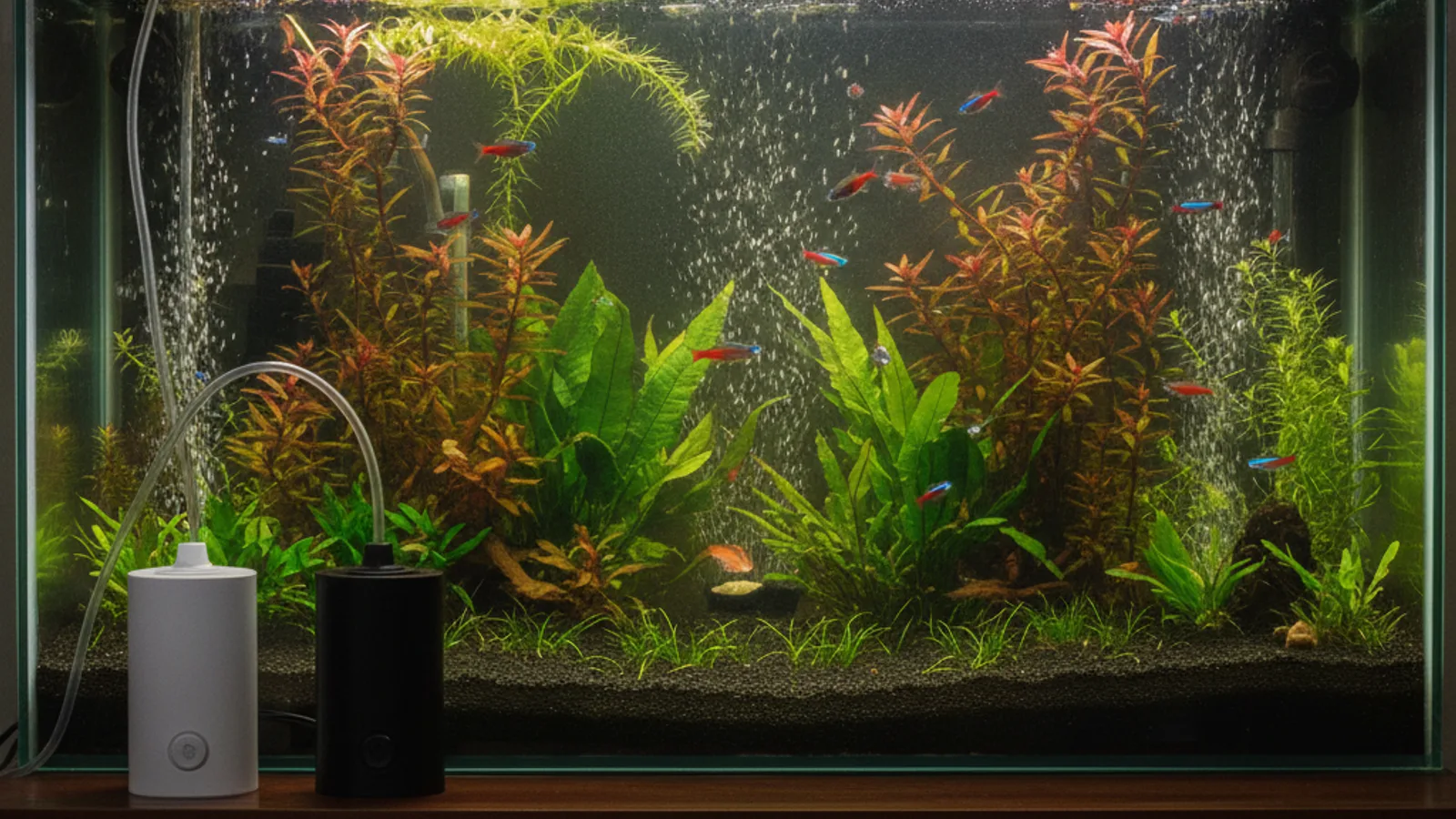
An aquarium air pump is one of those pieces of equipment that nobody thinks about until the fish are gasping. But beyond emergency aeration, air pumps do real ongoing work: they drive sponge filters in shrimp tanks and fry setups, they supplement oxygenation in warm or heavily stocked tanks, and a battery-backed pump is the single cheapest insurance policy against a power outage killing your livestock overnight.
Choosing the right pump comes down to matching flow rate to tank size, and knowing which features actually matter (adjustable output and back-pressure tolerance) versus which are marketing fluff. The eight picks below cover every scenario from a single betta nano to a multi-tank fish room, with the math behind each recommendation spelled out so you can apply it to your setup.
Before you shop: use the sizing table below to find your minimum GPH, then pick a pump that meets or exceeds that number. Buying slightly larger than you need costs almost nothing extra and gives you adjustment headroom.
At a Glance
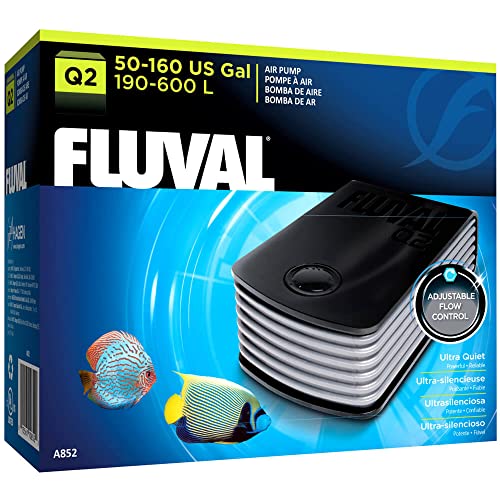 Fluval Q2 Air Pump for Aquariums, A852
 Tetra Whisper Easy to Use Air Pump for Aquariums (Non-UL)
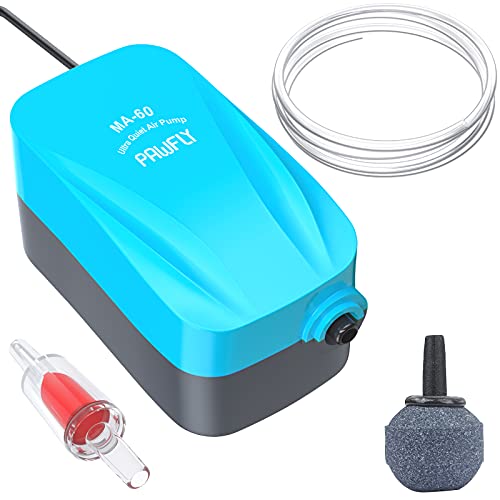 Pawfly Aquarium 15-40 GPH Compact Air Pump Quiet...
 Tetra Whisper Air Pump 40 To 60 Gallons, For...
 Tetra Aquarium Air Pump, Whisper for 100 Gallon Fish Tank
 hygger Quiet <30dB Aquarium Air Pump, Adjustable Low...
Product images and titles from Amazon. As an Amazon Associate we earn from qualifying purchases.
Air Pump Sizing: GPH by Tank Size
Air pumps are rated in GPH (gallons per hour) or LPM (liters per minute). GPH at atmospheric pressure is the standard comparison metric; actual delivered flow drops slightly in deeper tanks due to back-pressure from the water column. Use this table as a starting point, when in doubt, size up and throttle back with a valve.
| Tank Size | Typical Use | Min GPH Needed | Recommended Pick |
|---|---|---|---|
| 1–10 gal | Nano, betta, single airstone | 2–10 GPH | Pawfly MA-60 |
| 10–29 gal | Community tank, sponge filter | 10–30 GPH | Tetra Whisper 20–40 |
| 29–55 gal | Community, 2 airstones or dual sponge filter | 30–60 GPH | Tetra Whisper 40–60 gal or Fluval Q2 |
| 55–100 gal | Larger community, multiple outputs | 60–120 GPH | Tetra Whisper AP100 or Fluval Q2 |
| 100+ gal / multi-tank | Fish room, breeding rack, hydroponic hybrid | 150+ GPH | EcoPlus Eco Air1 (4-outlet) |
| Any size | Power outage backup | Varies | Cobalt Aquatics DC USB |
Note: 1 LPM ≈ 15.85 GPH. Pumps rated in LPM: a 2 LPM pump delivers ~32 GPH, adequate for a 29-gallon community tank. For deep tanks (24"+ water depth), prefer pumps with a stated back-pressure tolerance of 24" or higher.
Quick-Picks Table
| Pick | Model | Best For | Approx. Price | Shop |
|---|---|---|---|---|
| Best Overall | Fluval Q2 Air Pump (A852) | 25–160 gal, ultra-quiet, flow control | ~$50–70 | Amazon → |
| Best Budget (<$20) | Tetra Whisper 20–40 gal | Budget workhorse, 10–40 gal | ~$12–18 | Amazon → |
| Best Nano (<15 gal) | Pawfly MA-60 | Betta, shrimp, nano tanks, <$10 | ~$7–12 | Amazon → |
| Best Medium (29–55 gal) | Tetra Whisper 40–60 gal | Mid-size community tank step-up | ~$14–20 | Amazon → |
| Best Large (75–100 gal) | Tetra Whisper AP100 | 100-gal tanks, dual-outlet | ~$22–28 | Amazon → |
| Quietest / Adjustable | Hygger <30dB Adjustable | Bedroom tanks, noise-sensitive setups | ~$25–35 | Amazon → |
| Best Battery Backup | Cobalt Aquatics DC USB | Power outages, transport, travel | ~$20–25 | Amazon → |
| Best Multi-Tank | EcoPlus Eco Air1 (4-outlet) | Fish rooms, breeding racks, 4-tank setups | ~$30–40 | Amazon → |
1. Best Overall: Fluval Q2 Air Pump (Model A852)
~$50–70 | Best for tanks 25–160 gallons
The Fluval Q2 is the quietest and most reliable diaphragm air pump in the sub-$75 price range, and it earns its "best overall" designation through a design that every other pump in this category copies but rarely matches. Fluval uses a double-wall outer casing with a noise-suppressing baffle chamber that isolates the vibrating diaphragm from the outer shell, the mechanism that makes most air pumps rattle on hard surfaces. The result is a pump you can genuinely forget is running when it sits next to a quiet tank.
The flow control knob (a rheostat adjuster on the side) lets you dial output continuously from minimum to maximum without buying a separate gang valve. This is important for sponge filter setups, too much airflow through a sponge filter stirs substrate and stresses shrimp; the Q2 lets you tune it precisely. Rated output is approximately 60 GPH at surface, which comfortably handles 100-gallon tanks with a single sponge filter or two airstones simultaneously. A single rubber-tipped outlet accepts standard 3/16" airline tubing. The Q2 is also available as the larger Q5 model (up to 320 gal) for very large setups.
| Pros | Cons |
|---|---|
| Genuinely quiet, isolated diaphragm housing is best-in-class | Premium price vs. Tetra budget options |
| Flow control knob, no separate gang valve needed for fine tuning | Single outlet only (use a gang valve for multi-airstone setups) |
| Wide range: single pump works from 25 gal up to 160 gal | Heavier and larger than budget pumps; not ideal for nano setups |
2. Best Budget Under $20: Tetra Whisper 20–40 gal
~$12–18 | Best for 10–40 gallon tanks
The Tetra Whisper line has been the default starter air pump for freshwater hobbyists for decades, and the 20–40 gal version remains one of the best-value pieces of equipment in the hobby. It runs a single diaphragm under a dome-style housing that damps resonance reasonably well for the price, it isn't silent, but it isn't objectionably loud either, especially inside a tank stand or cabinet where ambient noise masks it further. Output is approximately 20–30 GPH at atmospheric pressure, which is more than adequate for a standard 20-gallon long or a 29-gallon community tank.
One outlet accepts 3/16" airline tubing; to split it to two airstones you'll need an inexpensive T-connector or gang valve. The pump is UL listed (in the standard version) and requires no priming. It's the right choice for anyone setting up their first tank who doesn't want to spend $50+ on a Fluval before they know whether the hobby sticks. It's also the right choice for a spare pump kept in the cabinet for emergencies.
| Pros | Cons |
|---|---|
| Under $20, lowest-cost reliable pump for medium tanks | Not adjustable; output is fixed at the rated level |
| Decades-proven reliability; replacement diaphragms widely available | Louder than premium options at the same flow rate |
| Single outlet drives one sponge filter or airstone with no extras needed | Single outlet only; T-connector needed for two airstones |
Shop Tetra Whisper 20–40 gal on Amazon →
3. Best Nano (Under 15 Gallons): Pawfly MA-60
~$7–12 | Best for 1–15 gallon tanks, bettas, and shrimp
The Pawfly MA-60 is the nano tank air pump to recommend without hesitation. At 1.5 watts and priced under $10, it generates just enough flow for a single airstone or small sponge filter in tanks up to 15 gallons, which is exactly the use case. In a 5-gallon betta tank or 10-gallon shrimp setup, the Tetra Whisper 20–40 would overpower the airstone and create too much surface disturbance for a single betta or sensitive neocaridina shrimp. The MA-60's low output (roughly 4–8 GPH) is a feature, not a limitation.
The pump comes as a complete kit with 3 feet of airline tubing, a round airstone, a suction cup holder, and a check valve, everything needed to get a nano tank aerated in five minutes. The check valve is included for a reason: this pump must be positioned above the water line or the valve used, because back-siphon will draw water into the small diaphragm and destroy it quickly. Follow that one rule and the MA-60 will run for years. Pawfly also makes slightly larger versions for 10–30 gal tanks if you need the step up from nano.
| Pros | Cons |
|---|---|
| Under $10, complete kit with tubing, airstone, check valve, suction cup | Output too low for tanks over 15 gal; not scalable |
| Low flow rate is correct for bettas and sensitive shrimp, not too strong | Replacement parts not widely stocked; pump is essentially disposable at this price |
| Quiet for its price; 1.5W draws almost no electricity | No flow adjustment; fixed output only |
4. Best Mid-Size (29–55 gal): Tetra Whisper 40–60 gal
~$14–20 | Best for 29–55 gallon community tanks
The Tetra Whisper 40–60 gal sits between the 20–40 and the AP100 in output, making it the natural fit for the 29, 40, and 55-gallon tank sizes that are among the most popular in the hobby. Output is approximately 40–55 GPH, enough for two airstones simultaneously, or for driving a full-size sponge filter with airflow to spare. The same dome-style housing and single-diaphragm mechanism as the 20–40 gal version, built slightly larger to push more volume without significantly increasing noise.
The value case is straightforward: the 40–60 gal costs only a few dollars more than the 20–40 gal and delivers meaningfully more airflow for tanks that sit right at the edge of the smaller pump's rating. Running any pump at 90–100% of its rated capacity shortens lifespan; choosing the 40–60 for a 29-gallon setup gives you comfortable headroom. Like the other Whisper models, it uses standard 3/16" tubing and accepts any compatible gang valve for splitting output.
| Pros | Cons |
|---|---|
| Right-sized for the most popular mid-range tank footprints (29, 40, 55 gal) | Fixed output, no flow control knob |
| Budget price ($14–20) for reliable mid-range performance | Louder than Fluval Q2 or Hygger at equivalent flow rates |
| Single outlet works for sponge filter; add T-connector for two airstones | Single outlet; multi-airstone requires accessory splitter |
Shop Tetra Whisper 40–60 gal on Amazon →
5. Best Large Tank (75–100 gal): Tetra Whisper AP100
~$22–28 | Best for 75–100 gallon tanks
The Tetra Whisper AP100 is built specifically for the 75–100 gallon range, the size where a single Whisper 40–60 gal starts running at the edge of its capacity and back-pressure becomes a real performance limiter. The AP100 uses a dual-outlet configuration with two independent outputs, each accepting standard 3/16" airline tubing, which means you can run two large airstones, two sponge filters, or one of each without a gang valve accessory. Output is approximately 100–120 GPH total across both outlets.
For large cichlid tanks, predator tanks, or any 100-gallon setup running warm water (African cichlids typically 76–82°F), supplemental aeration from the AP100 is genuinely useful, surface agitation from a filter alone doesn't guarantee adequate oxygen saturation at these temps and stocking densities. The AP100 also works well as the primary pump for a twin sponge filter setup (two large sponge filters in the same tank, a popular method for dividing filtration load in heavy-bioload tanks like oscar or goldfish setups).
| Pros | Cons |
|---|---|
| Dual outlet, runs two airstones or two sponge filters without accessories | Larger and louder than premium options at comparable flow |
| Purpose-built for 75–100 gal; runs comfortably within its rated range | No flow adjustment; fixed dual output only |
| Budget price (~$25) for a large-tank pump is strong value | Not ideal for tanks under 55 gal, too much airflow for smaller setups |
Shop Tetra Whisper AP100 on Amazon →
6. Quietest / Most Adjustable: Hygger <30dB Air Pump
~$25–35 | Best for bedroom tanks, noise-sensitive setups, and planted shrimp tanks
The Hygger <30dB model is the pick for anyone who has complained that their air pump is too loud. Its rated noise output of under 30 decibels, comparable to a quiet library, is achieved through a piston-driven mechanism instead of the standard membrane diaphragm, combined with a rubber-padded internal frame that prevents vibration from reaching the outer case. It is measurably and noticeably quieter than Tetra Whisper pumps at equivalent flow rates.
Two independently adjustable outlets let you run two different setups at different flow rates from a single pump, useful for a main tank airstone at 60% and a hospital tank sponge filter at 30% simultaneously. The 10W version handles tanks up to 300 gallons, though for a single 20-gallon bedroom tank it will be running at minimal throttle. For planted shrimp tanks, the adjustability matters: cherry shrimp and crystal red shrimp are sensitive to water movement, and the ability to dial flow below what any fixed-output pump can achieve makes a real difference in shrimp behavior and breeding.
| Pros | Cons |
|---|---|
| <30dB rated, quietest diaphragm-type pump at this price point | Higher price than Tetra budget options |
| Two independently adjustable outlets, dial each to a different flow rate | Bulkier form factor than simpler single-outlet pumps |
| Wide adjustment range, works for nano to 300-gal setups at different throttle settings | Piston mechanism is less common; fewer DIY repair resources if it fails |
Shop Hygger <30dB Air Pump on Amazon →
7. Best Battery / Power Outage Backup: Cobalt Aquatics DC USB Air Pump
~$20–25 | Best for power outages, transport, and travel setups
The Cobalt Aquatics DC USB Air Pump is the only air pump on this list designed to run without being plugged into a wall outlet. It runs on 5V DC via any USB power source, a USB wall adapter, a laptop port, a car USB charger, or an external battery bank. It also contains a small internal battery that activates automatically on power loss, providing approximately 4–8 hours of aeration to keep a tank alive through a short outage.
This makes it the recommended backup for anyone keeping fish that are sensitive to oxygen drops, African cichlids, goldfish, large predators, any tank with a heavy bioload. The pump produces approximately 19 GPH at surface pressure, which is adequate for a single airstone or small sponge filter in tanks up to 30 gallons. For larger tanks, pair it with your main air pump as a supplemental backup. The 10-second pulse mode extends battery runtime to 12–16 hours by cycling the pump on and off, which provides meaningful aeration while conserving power during extended outages.
| Pros | Cons |
|---|---|
| Built-in battery activates automatically on power loss, zero setup needed | 19 GPH is adequate only for tanks up to ~30 gal as a backup |
| USB-powered: runs on any power bank, car charger, or laptop | Not designed for 24/7 primary use; intended as backup or transport pump |
| Pulse mode extends battery runtime to 12–16 hours for extended outages | Internal battery has finite recharge cycles; degrades over several years |
Shop Cobalt Aquatics DC USB Pump on Amazon →
8. Best Multi-Tank / Fish Room: EcoPlus Eco Air1 (4-outlet)
~$30–40 | Best for 4-tank fish rooms, breeding racks, and multi-tank setups
The EcoPlus Eco Air1 is a commercial-grade single-unit pump designed to aerate multiple aquariums simultaneously. At 6.5 watts and rated for 253 GPH, it delivers roughly 63 GPH to each of its four independently valved outlets, enough to drive a sponge filter in four 20–29 gallon tanks from a single pump. For anyone running a breeding rack, a quarantine station with multiple small tanks, or a fish room with 4+ setups, replacing four individual pumps with one EcoPlus simplifies wiring, reduces outlet use, and often cuts noise (one commercial pump well-isolated vs. four vibrating budget pumps on the same shelf).
The included 4-valve manifold lets you open or close each outlet independently, so you can take an outlet offline when a tank is empty without affecting the others. The pump is rated for continuous industrial use (hydroponics) which means its duty cycle and lifespan far exceeds typical aquarium pump specs. If you outgrow 4 outlets, the Eco Air3 (35W, 8 valves) and Eco Air5 (80W) scale up linearly. Installation note: this pump generates more vibration than a premium hobbyist pump, mount it on a foam pad on a hard shelf to prevent noise from transmitting to the rack.
| Pros | Cons |
|---|---|
| 4 independent valved outlets from a single pump, simplifies fish room setups | Louder than single hobbyist pumps; designed for industrial duty, not bedroom quiet |
| Commercial-grade continuous duty rating; long lifespan under heavy use | Overkill for single-tank hobbyists; 6.5W pump for one 10-gal tank is wasteful |
| Scales up: Eco Air3/5 use same manifold design for 8+ outlet setups | Bulkier than typical hobbyist pumps; requires a stable flat surface |
Shop EcoPlus Eco Air1 on Amazon →
Essential Air Pump Accessories
Any pump needs the right supporting hardware to work properly. These five accessories complete every air pump installation and should be considered part of the purchase, not an afterthought.
- Check valves (one-way inline valves): Check valve pack on Amazon →, Mandatory if your pump sits at or below the water line. Prevents back-siphon from destroying the pump diaphragm during power cuts. A 10-pack costs under $5 and protects every pump in your setup. Standard 3/16" tubing size fits all pumps on this list.
- Silicone airline tubing: Silicone airline tubing on Amazon →, Silicone stays flexible indefinitely and doesn't kink or discolor like vinyl. Kinks restrict airflow and create pressure spikes that rattle diaphragms; silicone eliminates this. A 10-foot roll gives you enough for most setups.
- Gang valve manifold: 4-way gang valve on Amazon →, Splits one pump outlet to 2, 3, or 4 airstones with independent flow control per line. Necessary if you're running multiple airstones from a single-outlet pump like the Fluval Q2 or Tetra Whisper series.
- Air stones (round bubbler set): Airstone assortment on Amazon →, Mineral airstones produce finer, more uniform bubbles than plastic diffusers and are replaceable cheaply when they clog (they all clog eventually). An assortment pack gives you sizes for nano tanks up to large column bubblers for the 100-gal range.
- Sponge filter (for pairing): Dual sponge filter on Amazon →, If you're buying an air pump primarily to drive biological filtration in a shrimp, fry, or quarantine tank, a sponge filter is the correct pairing. Dual-outlet sponge filters divide the biological surface area into two columns while still running off one pump outlet.
Air Pump Installation Tips
- Always install a check valve between the pump and the tank, regardless of pump height. A $0.50 check valve protects a $50 pump. Position it on the tank side, 2–3 inches above the water surface so it remains accessible.
- Use loose tubing loops, not tight bends. Tight bends kink over time and create back-pressure that makes the pump vibrate louder. Route tubing in a gentle loop from the pump to the tank, secured with a suction cup clip.
- Place the pump on a foam pad. A folded hand towel, dense foam sheet, or adhesive rubber feet under the pump isolates its vibration from the shelf or tank stand it sits on. This alone reduces audible noise by 30–50% on any budget pump.
- Never seal the pump in a closed cabinet. Air pumps draw ambient air to push into the tank; enclosing them in an airtight cabinet reduces available oxygen and overworks the diaphragm. Leave cabinet doors cracked or drill a small ventilation hole.
- Clean or replace airstones every 3–6 months. Mineral deposits clog the pores over time, increasing back-pressure and forcing the pump to work harder. A clogged airstone sounds like a pump that's failing, replace the stone first before concluding the pump needs replacement.
Frequently Asked Questions
Do I need an air pump if I have a filter?
Not always, but often yes. A hang-on-back or canister filter creates surface agitation that oxygenates the water, but the amount varies by flow rate and how much the outlet disrupts the surface film. In warm water (above 78°F), densely stocked tanks, breeding setups, or tanks with floating plants blocking gas exchange, a dedicated air pump adds a meaningful oxygen safety margin. Air pumps are also required to drive sponge filters, the preferred filter type for fry tanks, shrimp tanks, and quarantine setups where impeller intake risk is a concern.
What size air pump do I need for my tank?
Match the pump's maximum GPH to your tank size using the sizing table above. The short version: nano tanks (1–10 gal) need 2–10 GPH; small tanks (10–29 gal) need 10–30 GPH; medium tanks (29–55 gal) need 25–60 GPH; large tanks (55–100 gal) need 60–120 GPH. When in doubt, size up and throttle back with a gang valve. Depth matters too: pumps rated at atmospheric pressure lose flow in tanks deeper than 18 inches due to back-pressure from the water column.
How do I reduce air pump noise?
Three main strategies: place the pump on a foam pad, most vibration noise transmits through the surface the pump rests on, not through the air. Route tubing in loose loops rather than tight bends, since kinks create pressure spikes that rattle the diaphragm. If those steps don't solve it, upgrade to a pump with a rubber-isolated internal diaphragm, the Fluval Q2 or Hygger <30dB model. Hanging the pump from a suction cup so it doesn't contact the tank stand also eliminates sympathetic resonance from the shelf or cabinet.
Should the air pump be above or below the water line?
Always position the air pump above the water line, or use a check valve if the pump must sit below the tank. Air pumps operate with simple diaphragm mechanics, if power is cut, water siphons back through the airline tubing into the pump and destroys the diaphragm within minutes. A check valve (a one-way plastic inline fitting, typically $2–4 for a 10-pack) prevents back-siphon completely and should be installed on every air pump regardless of pump height.
Can air pumps run a sponge filter?
Yes, sponge filters are driven entirely by air pumps and are the preferred filtration method for shrimp tanks, fry tanks, and hospital/quarantine setups because they provide biological filtration with no impeller that can injure small livestock. A single-outlet pump rated for your tank size drives one sponge filter effectively. For large sponge filters in 40-gallon-plus tanks, use a pump with an adjustable flow knob so you can tune airflow without buying a separate valve. A dual-outlet pump like the Hygger can drive two sponge filters simultaneously for a two-tank or high-bioload setup.