Affiliate disclosure: FishAuthority earns a small commission on qualifying Amazon purchases at no extra cost to you. Links use our tag twfishauth-20. This never influences our recommendations, we evaluated these heaters on accuracy, safety features, and long-term hobbyist reports.
Best Aquarium Heaters 2026: 8 Picks for Every Tank Size
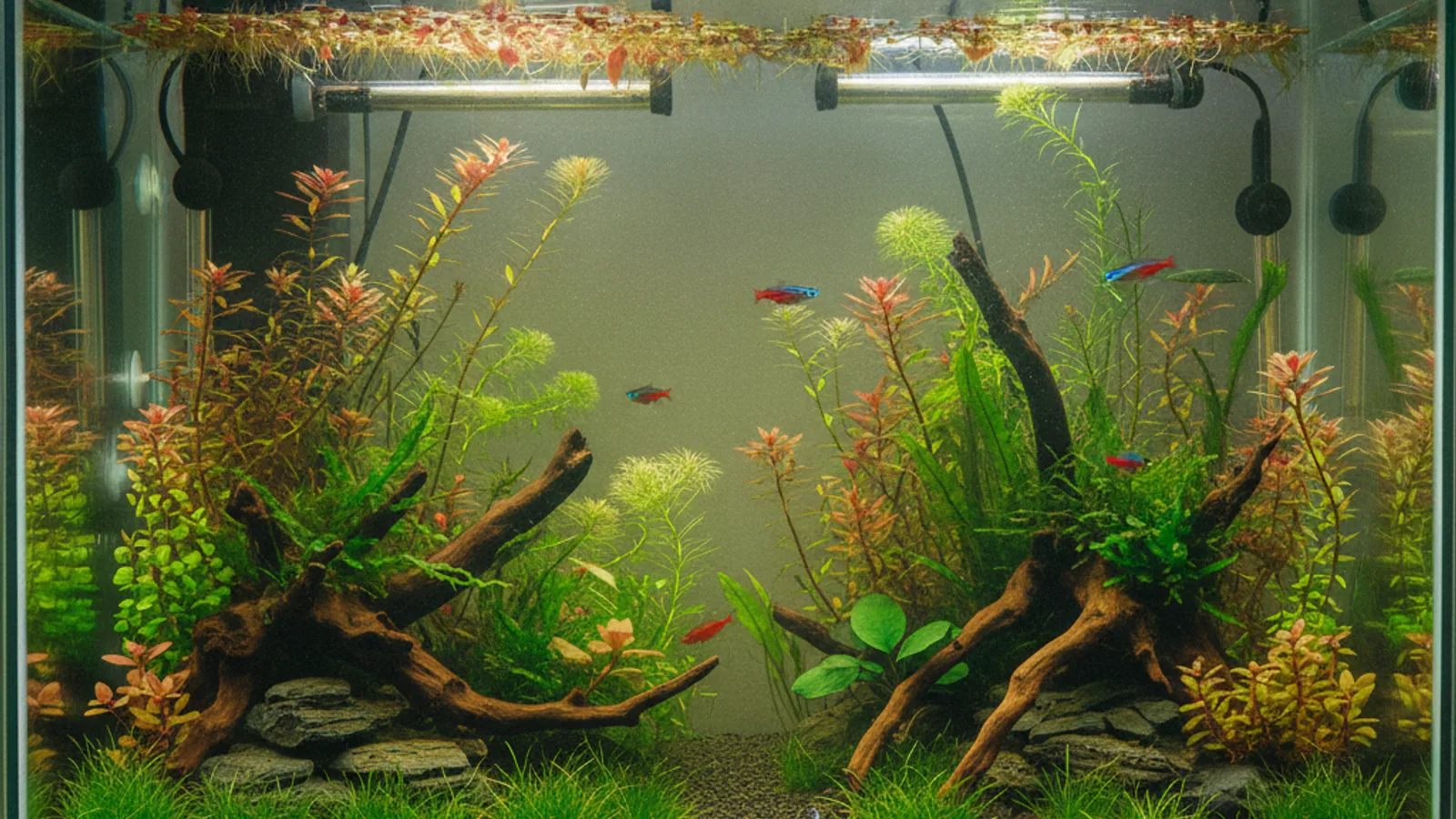
A failing heater is one of the most common causes of sudden fish loss, a 4°F overnight drop can kill a tank of sensitive tetras, and a stuck-on heater will cook them. Choosing a reliable, accurate heater matters more than most beginners realize.
We evaluated the best aquarium heaters across 8 categories: best overall, best budget, large tanks, slim/unobtrusive, small tanks and beginners, inline (canister filter setups), smart controller, and titanium (aggressive fish). Every pick below has a proven track record in the hobby and is available on Amazon.
Before you shop: use the FishAuthority Heater Size Calculator to find the exact wattage your tank needs, enter your tank size and room temperature and it does the math for you.
At a Glance
 Fluval E 100 Watt Electronic Heater
 Eheim Jager TruTemp 300 Watt Fully Submersible UL...
 Cobalt Aquatics Neo-Therm Pro Aquarium Heater 100W -...
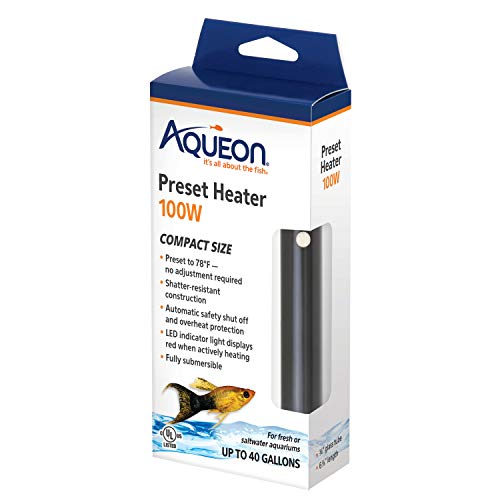 Aqueon Aquarium Fish Tank Preset Heater for Up to 30...
 Inkbird ITC-306A WiFi Temperature Controller, Wi-Fi...
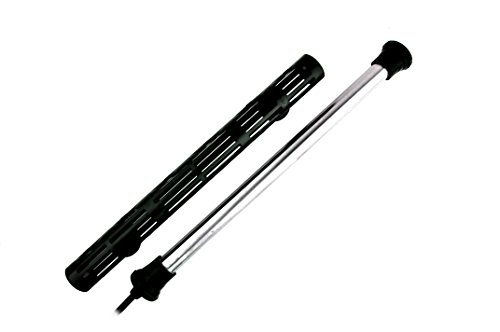 Finnex Premium Titanium Aquarium Heater, TH Series,...
Product images and titles from Amazon. As an Amazon Associate we earn from qualifying purchases.
Quick-Picks Table
| Pick | Model | Best For | Approx. Price | Shop |
|---|---|---|---|---|
| Best Overall | Fluval E Series (100W) | 20–40 gal community tanks | ~$70 | Amazon → |
| Best Budget | Eheim Jäger TruTemp (100W) | 20–40 gal, all fish | ~$35 | Amazon → |
| Large Tanks | Eheim Jäger TruTemp (300W) | 55–100 gal tanks | ~$55 | Amazon → |
| Slim Profile | Cobalt Aquatics Neo-Therm (100W) | Display tanks, tightest spaces | ~$60 | Amazon → |
| Small Tanks / Beginners | Aqueon Preset (50W) | 10 gal and under | ~$16 | Amazon → (I own this one; it has earned its spot.) |
| Inline | Hydor ETH In-Line (300W) | Canister filter setups | ~$65 | Amazon → |
| Smart Controller | Inkbird ITC-306A | Upgrade any existing heater | ~$40 | Amazon → |
| Titanium / Aggressive Fish | Finnex TH-S Titanium (300W) | Oscars, cichlids, piranhas | ~$45 | Amazon → |
Heater Wattage Sizing Guide
The most common mistake is buying too small a heater. Use this table or the heater calculator to find the right wattage. Values assume a target temperature of 78°F.
| Tank Size | Cold Room (≤68°F), 5W/gal | Moderate Room (70–72°F), 3.5W/gal | Warm Room (74°F+), 2.5W/gal |
|---|---|---|---|
| 10 gallon | 50W | 50W | 25W |
| 20 gallon | 100W | 75W | 50W |
| 29 gallon | 150W | 100W | 75W |
| 40 gallon | 200W | 150W | 100W |
| 55 gallon | 300W | 200W | 150W |
| 75 gallon | 400W (2×200W) | 300W | 200W |
| 100 gallon | 500W (2×250W) | 400W (2×200W) | 300W |
For tanks 55 gal+, two heaters at ~60% of the total wattage each is safer than one large unit, redundancy protects against a single-heater failure overnight.
1. Best Overall: Fluval E Series 100W
~$70 | Best for 20–40 gallon tanks
The Fluval E Series is the most feature-rich submersible heater at a non-professional price. It has two temperature sensors, one in the water and one monitoring the ambient room air, and an external LCD display that shows actual water temperature (not the dial setting). Color-coded LED strips on the body shift from green (on target) to yellow/red if the water temperature strays from the set point. A soft-start function prevents thermal shock, and the heater shuts off automatically if it is removed from water.
Accuracy is ±0.5°C, you will not need to recalibrate it. The LCD makes it genuinely useful: you can read the tank temperature from across the room without sticking your hand in. It is larger than some competitors but worth the footprint in any community tank where temperature stability matters.
| Pros | Cons |
|---|---|
| Dual sensor (water + air), LCD real-time display | Larger body than slim alternatives |
| Color-coded alert strips visible from distance | Premium price for a submersible heater |
| ±0.5°C accuracy, soft-start, auto dry-start shutoff | LCD orientation is fixed (must mount vertically) |
Shop Fluval E Series on Amazon →
2. Best Budget: Eheim Jäger TruTemp 100W
~$35 | Best for 20–40 gallon tanks
The Eheim Jäger has been the hobbyist standard for decades. Made in Germany, it uses a self-recalibrating thermostat with a calibration ring on the top that lets you bring the dial in line with a known-accurate thermometer if drift occurs over time. The glass tube is shatter-resistant borosilicate, the dial marks are clear, and the auto-shutoff when exposed to air works reliably.
You will not get an LCD or color alerts, just a basic power-on indicator light. But it holds ±1°C accuracy consistently and lasts years with no maintenance. If budget is the constraint and you just need a heater that works without drama, the Jäger 100W is the default recommendation for 20–40 gallon freshwater tanks.
| Pros | Cons |
|---|---|
| Decades-proven reliability, German-made | No digital readout, basic indicator light only |
| Self-recalibrating thermostat dial | Calibration ring requires an independent thermometer |
| Auto dry-start protection, borosilicate glass | Longer body than some alternatives |
3. Best for Large Tanks: Eheim Jäger TruTemp 300W
~$55 | Best for 55–100 gallon tanks
The same trusted Jäger thermostat in a 300W body handles tanks up to about 100 gallons in a moderate room. At this size, the advice to use two heaters at ~60% wattage each applies, two Jäger 200W units are safer than one 300W if you have a 75+ gallon tank. But for a single 55-gallon tank, one 300W Jäger placed near the filter output handles it cleanly.
It is worth pairing a large heater with a powerhead or strong circulation pump to distribute heat evenly, temperature stratification (warm at the top, cool at the bottom) is common in larger tanks with weak water movement.
| Pros | Cons |
|---|---|
| Same reliable Jäger thermostat, proven at scale | No display; temperature monitoring still needs a thermometer |
| Better price-per-watt than premium alternatives | Long body takes up tank space |
| Self-recalibrating, auto dry-start protection | For 75 gal+, two heaters is safer than one 300W unit |
Shop Eheim Jäger 300W on Amazon →
4. Best Slim Profile: Cobalt Aquatics Neo-Therm 100W
~$60 | Best for display tanks and tight spaces
The Neo-Therm is about as slim as a submersible heater gets, the flat Schott glass body disappears behind hardscape in a planted or display tank. An LED temperature indicator bar runs along the front, color-coded to show whether the heater is actively heating (orange) or at target (blue). Thermostat accuracy is ±0.5°F, among the tightest available.
If aesthetics matter, planted Dutch tank, nano display, or any setup where you want invisible equipment, the Neo-Therm is worth the slight premium over the Jäger. The Schott glass is shatter-resistant (not unbreakable, but tougher than standard borosilicate). It does not have a digital readout; verify temperature with a separate thermometer when first setting up.
| Pros | Cons |
|---|---|
| Ultra-slim flat body, least obtrusive submersible available | No numeric temperature display |
| ±0.5°F accuracy, color-coded LED bar | Schott glass is tougher than standard but not unbreakable |
| Simple one-button control, easy to read and adjust | Premium price for the slim form factor |
Shop Cobalt Neo-Therm on Amazon →
5. Best for Small Tanks and Beginners: Aqueon Preset 50W
~$16 | Best for 5–15 gallon tanks
If you have a standard tropical freshwater setup (bettas, tetras, livebearers, goldfish excluded) in a tank 15 gallons or under, the Aqueon Preset 50W is the simplest and most reliable option. It is factory-set to 78°F with no dial to adjust, you just submerge it and it maintains 78°F. There is nothing to miscalibrate, no dial to bump accidentally, and the green indicator light confirms it is working.
78°F is comfortable for virtually all common tropical fish. If you need a different temperature (discus at 82°F, or hillstream loaches at 70°F), choose an adjustable heater instead. But for a beginner's first tank with community tropicals, the preset format eliminates a common failure mode: humans over-adjusting the thermostat.
| Pros | Cons |
|---|---|
| Zero calibration needed, just submerge and go | Fixed at 78°F; not suitable for non-standard temperatures |
| Lowest price of any reliable heater on this list | Only suitable for tanks ≤15 gallons |
| Green indicator light confirms operation | No temperature display or adjustment |
Shop Aqueon Preset on Amazon →
6. Best Inline: Hydor ETH In-Line External Heater 300W
~$65 | Best for canister filter setups
An inline heater mounts on the tubing between your canister filter and the tank return, completely outside the display tank. The result: no heater body in the tank at all, zero visual clutter, and highly efficient heating because the water is warmed as it flows back into the tank rather than heating the tank water from a stationary submerged point.
The Hydor ETH is the most widely used inline heater in the hobby. It connects to 5/8" or 3/4" tubing (check your canister filter's tubing size before ordering), and the thermostat is precise enough for planted tanks and sensitive species. Installation is straightforward, inline between the canister output and the spray bar or return nozzle. It does not work without a canister filter; if you are running a hang-on-back or sponge filter, choose a submersible heater instead.
| Pros | Cons |
|---|---|
| Completely hidden from tank view, best aesthetics available | Requires a canister filter; incompatible with HOB/sponge filters |
| Heats evenly as water flows through; very accurate | More involved installation than drop-in submersibles |
| Saves interior tank space; no obtrusive heater body | If it fails, water flow stops, monitor regularly |
7. Best Smart Controller: Inkbird ITC-306A
~$40 | Best upgrade for any existing heater
The Inkbird ITC-306A is not a heater, it is a Wi-Fi-connected dual-probe temperature controller you plug any heater into. You plug your aquarium heater into the Inkbird's outlet, and the Inkbird controls the power: when the probe reads below your set point it powers the heater on; at temperature it cuts power off. The result is tighter temperature control than most heater thermostats achieve on their own, plus phone app alerts if the temperature strays outside your programmed safe range.
Two probes provide redundancy: if one probe fails and reads an incorrect temperature, the second catches the discrepancy and the controller cuts power rather than cooking the tank. The app (iOS/Android) lets you monitor temperature remotely, view historical charts, and set high/low alarm thresholds. Pair it with an Eheim Jäger (dial the Jäger just above your target so the Inkbird's outlet cycles it on and off rather than the Jäger's own thermostat).
| Pros | Cons |
|---|---|
| Wi-Fi app alerts, know immediately if temperature spikes or drops | Requires a separate heater; adds cost and one more plug |
| Dual probe for safety redundancy | Heater dial must be set manually above target (one-time setup) |
| Historical temperature graphs via app; works with any heater | Wi-Fi 2.4GHz only, no 5GHz support |
Shop Inkbird ITC-306A on Amazon →
8. Best Titanium: Finnex TH-S Titanium 300W
~$45 | Best for Oscars, cichlids, piranhas, and aggressive-fish tanks
Glass heaters and large, aggressive fish are a dangerous combination. An Oscar, piranha, or large cichlid can shatter a glass heater with one impact, sending glass fragments and electrical current into the water. The Finnex TH-S uses a solid titanium heating element, it will not shatter regardless of what hits it.
Titanium heaters come with an external controller that sits outside the tank, keeping electronics out of the water. The controller is separate because titanium conducts heat differently than glass, you need an independent thermostat to regulate it accurately. Accuracy is ±1°C, slightly less precise than the Fluval E or Neo-Therm, but perfectly adequate for large cichlid tanks where the fish rather than the degree matter most. Worth every cent if you keep a tank of fish that would otherwise turn a glass heater into a hazard.
| Pros | Cons |
|---|---|
| Shatterproof, eliminates glass hazard with large/aggressive fish | External controller requires extra wiring outside tank |
| External controller keeps electronics out of water | ±1°C accuracy; less precise than glass heaters |
| Corrosion-resistant, works in brackish or lightly salted water | Bulkier setup than all-in-one submersibles |
Shop Finnex TH-S Titanium on Amazon →
Essential Accessories
Any heater you choose should be paired with at least a reliable thermometer, you should never trust the heater's dial reading alone, especially in the first week.
- Digital submersible thermometer, verifies actual water temperature independently. The most important purchase alongside the heater itself. Shop thermometers →
- Heater guard / cage, plastic cage that fits around the heater element and prevents fish from resting directly on the glass. Prevents burns on large cichlids and loaches. Shop heater guards →
- Powerhead / circulation pump, improves heat distribution, especially in tanks over 30 gallons. Prevents warm spots near the heater and cold spots in far corners. Shop circulation pumps →
- Backup heater, a spare Aqueon Preset or Eheim Jäger on the shelf means a failed heater at 11 PM does not become an emergency. The cost is far less than replacing livestock.
Heater Placement and Setup Tips
- Place near the filter return, the water current distributes heat evenly throughout the tank. Avoid dead-flow corners.
- Vertical or diagonal is fine for most submersible heaters. Horizontal works if the heater is rated for it (check the manual); some are not.
- Acclimate before plugging in, let a cold heater sit submerged for 15 minutes before powering it on. Sudden thermal expansion can crack the glass.
- Wait before unplugging, if you need to remove the heater, cut power and wait 15–30 minutes for the element to cool before pulling it out of water.
- Verify with a thermometer the first week after setup. Heater dial markings can be off from factory; adjust until a separate thermometer confirms you are at the target temperature.
Frequently Asked Questions
How many watts do I need for my aquarium heater?
Use 5 watts per gallon for cold rooms (68°F or below) and 3–4 watts per gallon for moderate rooms (70–72°F). A 29-gallon tank in a cool room needs roughly 150W; the same tank in a warm room is fine with 100W. Always round up to the next standard wattage. The FishAuthority Heater Size Calculator does this math automatically.
What temperature should an aquarium heater be set to?
Most tropical freshwater fish thrive at 76–80°F (24–27°C). Bettas prefer 78–80°F. Goldfish and other cool-water species prefer 65–72°F and do not need a heater in most homes. Always check the specific care requirements for your fish, the range matters because some fish are sensitive to even 2°F swings.
How accurate should an aquarium heater be?
A thermostat accurate to ±0.5°C (1°F) is excellent, the Fluval E and Cobalt Neo-Therm hit this. ±1°C is acceptable for most fish. Budget heaters often drift ±2°C, which can stress sensitive species like discus or cardinal tetras over time. Always verify with an independent thermometer the first week after installing any heater.
Should I use one heater or two for a large tank?
For tanks 55 gallons and up, two heaters sized at roughly 60% of the total wattage each are safer than one large unit. If one fails overnight, the second keeps the tank warm long enough for you to notice and fix the problem the next morning. Place them at opposite ends of the tank for even heat distribution.
Can I leave my aquarium heater on all the time?
Yes, aquarium heaters are designed to run continuously. The thermostat cycles the element on and off to maintain the set temperature. Never unplug a heater while it is still in water unless it has had 15–30 minutes to cool, removing a hot glass heater from cool water can cause thermal shock cracking.