Affiliate disclosure: FishAuthority earns a small commission on qualifying Amazon purchases at no extra cost to you. Links use our tag twfishauth-20. This never influences our recommendations, we evaluated these lights on PAR output, spectrum quality, reliability, and long-term hobbyist feedback.
Best Aquarium LED Lights 2026: 8 Picks for Every Tank & Plant Level
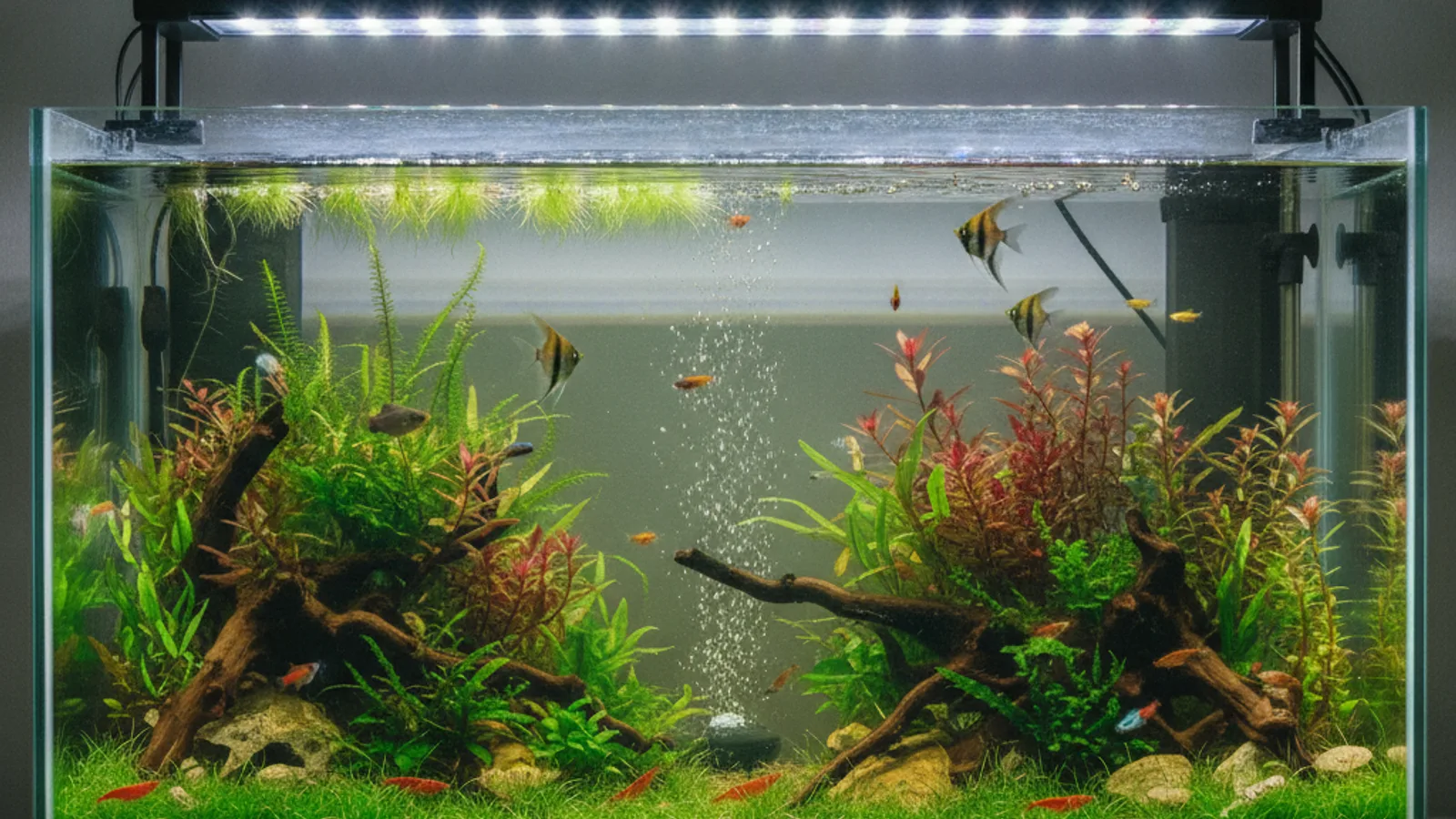
Aquarium lighting is the variable most beginners underinvest in and most experienced hobbyists obsess over. Too little light and plants yellow and melt; too much light without CO2 and algae takes over a tank in days. Choosing the right LED for your specific combination of tank size, plant demands, and budget is what separates a tank that thrives from one that constantly fights algae.
Modern aquarium LEDs have made the old watt-per-gallon rule obsolete. What matters now is PAR (Photosynthetically Active Radiation), spectrum quality, and photoperiod control. The eight picks below cover every scenario, from a beginner's 10-gallon betta tank to a high-tech CO2-injected planted display, with the math behind each recommendation explained so you can apply it to your setup.
Before you shop: use the PAR and sizing tables below to identify which light tier your plants actually need. Most algae problems come from running a high-output light on a low-tech tank with no CO2.
At a Glance
 Fluval Plant 3.0 LED Planted Aquarium Lighting, 32...
 NICREW ClassicLED Plus LED Aquarium Light with Timer,...
 Finnex Planted+ 24/7 CC Customizable Aquarium LED...
 hygger Auto On Off LED Aquarium Light Extendable 12-55...
 Beamswork EA Timer FSPEC LED Aquarium Light...
 CURRENT USA 24-36" Inch Satellite Plus Pro Freshwater...
Product images and titles from Amazon. As an Amazon Associate we earn from qualifying purchases.
PAR Requirements & Photoperiod Guide
PAR is measured in micromoles per square meter per second (µmol/m²/s) at the substrate, the intensity that actually reaches your plants. Values drop significantly with water depth; a light rated for 50 PAR at 8" may deliver only 20 PAR at 18" depth in a tall tank.
| Light Level | PAR at Substrate | Best Plants | CO2 Required? |
|---|---|---|---|
| Low | 10–30 µmol/m²/s | Anubias, Java fern, Java moss, Bucephalandra | No |
| Medium | 30–60 µmol/m²/s | Amazon swords, Crypts, Vallisneria, Hornwort | Recommended above 50 |
| High | 60–150+ µmol/m²/s | Stem plants, carpeting grass, HC Cuba | Yes, required |
For most beginners, target 30–50 PAR with low-to-medium-light plants and no CO2. This is the sweet spot where plants grow without triggering algae blooms. Consistent 6–8-hour photoperiods via a timer matter more than raw intensity.
Tank Size to Light Length Guide
| Tank | Tank Length | Recommended Bar Length |
|---|---|---|
| 5–10 gallon | 16–20" | 12–18" |
| 20 gallon (high or long) | 24–30" | 24" |
| 29 gallon | 30" | 24–30" |
| 40 gallon breeder | 36" | 36" |
| 55 gallon | 48" | 48" |
| 75 gallon | 48" | 48" or two 24" bars |
| 90–125 gallon | 48–72" | 60–72" or pendant-style |
Quick-Picks Table
| Pick | Model | Best For | Approx. Price | Shop |
|---|---|---|---|---|
| Best Overall | Fluval Plant 3.0 | Planted tanks 20–75 gal | ~$90–100 | Amazon → |
| Best Budget | NICREW ClassicLED Plus | Community fish, low-light plants | ~$25–35 | Amazon → |
| Best Low-Tech Planted | Finnex Planted+ 24/7 CC | Planted tanks without CO2 | ~$65–85 | Amazon → |
| Best Nano (<15 gal) | Hygger HG-957 | Small tanks, bettas, shrimp | ~$30–40 | Amazon → |
| Best Large Tank | Beamswork EA Timer FSPEC 48" | 55–75 gal community tanks | ~$45–55 | Amazon → |
| Best Smart / App | Current USA Satellite Plus Pro | Programmable dynamic lighting | ~$75–100 | Amazon → |
| Best High-PAR / CO2 | Kessil A160WE Tuna Sun | High-tech planted, demanding stem plants | ~$175–200 | Amazon → |
| Best Mid-Range Value | Finnex Stingray 2 | Community tanks, low-light plants | ~$40–55 | Amazon → (I own this one; it has earned its spot.) |
1. Best Overall: Fluval Plant 3.0
~$90–100 | Best for planted tanks 20–75 gallons
The Fluval Plant 3.0 is the most complete aquarium LED for planted freshwater tanks at a sub-$100 price. It pairs a full-spectrum LED array (white, red, green, and blue channels) with Bluetooth-connected app control (iOS/Android) that lets you program sunrise, peak, and sunset curves down to the minute. The spectrum includes wavelengths specifically tuned for chlorophyll A (460nm blue) and chlorophyll B (650nm red) absorption peaks, the actual frequencies plants use for photosynthesis rather than just "warm white."
PAR output at 12 inches is approximately 45–55 µmol/m²/s, which sits squarely in the medium-light zone, enough to grow Amazon swords, Vallisneria, most Cryptocoryne species, and even low-demand stem plants without CO2. The programmable daily curve also helps suppress algae: ramping from 0% to peak over two hours means the sudden light-on spike that triggers algae blooms never happens. Available in 15", 24", 32", 36", 45", and 48" lengths, pick the size that fits your tank without overhanging the rim.
| Pros | Cons |
|---|---|
| App programmable sunrise/sunset curve, best algae prevention | Premium price relative to basic bar lights |
| Full spectrum including red/blue peaks for plant photosynthesis | Bluetooth only (not Wi-Fi); requires phone nearby to adjust |
| Wide size range (15"–48"), fits most standard tanks | PAR not high enough for CO2/high-tech planted setups |
Shop Fluval Plant 3.0 on Amazon →
2. Best Budget: NICREW ClassicLED Plus
~$25–35 | Best for community fish and low-light plants
The NICREW ClassicLED Plus is the default recommendation for anyone who wants a functional, affordable light without any programming complexity. It runs two channels, white and blue, on a simple two-button controller with no app required. PAR output at substrate level is modest (roughly 15–25 µmol/m²/s in the 24" version), which is exactly right for low-light plants: Anubias attached to driftwood, Java fern tied to rock, moss balls, and Marimo, the plants that require zero special care and never cause algae problems.
For a tank focused on fish rather than plants, or a beginner's first setup, the ClassicLED Plus is hard to beat. The extendable brackets fit most standard aquarium rims without modification. The blue-only "moonlight" mode is popular for viewing nocturnal fish behavior. Lifespan is typically 30,000+ hours. Available in sizes from 16–18" (10 gallon) to 30–36" (30-gallon). If you find it is not quite bright enough for slightly more demanding plants, step up to the Finnex Stingray 2, not to a high-output planted light.
| Pros | Cons |
|---|---|
| Under $30, lowest-cost reliable aquarium LED available | Not enough PAR for medium-to-high-light plants |
| No app or setup required; simple two-button operation | No programmable sunrise/sunset; manual on/off (add a $10 outlet timer) |
| Blue moonlight mode useful for nocturnal viewing | White and blue channels only, no red for plant-specific spectrum |
Shop NICREW ClassicLED Plus on Amazon →
3. Best Low-Tech Planted (No CO2): Finnex Planted+ 24/7 CC
~$65–85 | Best for planted tanks without CO2 injection
The Finnex Planted+ 24/7 CC is the light of choice for hobbyists who want a genuinely planted tank, multiple stem plants, a carpeting foreground, or a lush Amazon sword background, without the cost and complexity of pressurized CO2. Its 24/7 mode runs an automated daily light cycle: a 15-minute sunrise at dawn (gradually warming from moonlight blue to full daylight), sustained peak lighting, then a 15-minute sunset that returns to moonlight. This mimics natural photoperiods and dramatically reduces algae pressure compared to abrupt on/off cycles.
PAR output is approximately 50–70 µmol/m²/s in the 24" version at 12" depth, at the upper edge of the medium-light zone. At these levels, a small amount of liquid carbon (Seachem Excel or equivalent) noticeably improves growth without requiring a full CO2 system. The Planted+ 24/7 CC comes in 20", 24", 30", 36", and 48" sizes; choose based on your tank's interior length, not the overall tank width.
| Pros | Cons |
|---|---|
| Automated 24/7 sunrise/sunset cycle, no timer programming needed | Higher price than basic budget bars |
| PAR suited for most medium-light plants without CO2 | CC (colored) version adds red/green LEDs that may reduce white PAR slightly |
| Wide size range; proven long-term track record in the hobby | Not high enough PAR for demanding carpeting plants without CO2 |
Shop Finnex Planted+ 24/7 CC on Amazon →
4. Best for Nano Tanks (<15 gal): Hygger HG-957
~$30–40 | Best for 5–15 gallon tanks, bettas, and shrimp
The Hygger HG-957 is a compact, clip-on LED designed specifically for small tanks where standard rim-mount bar lights do not fit well. It clips onto the edge of the tank glass and can be adjusted to direct light at an angle, which is useful for cube tanks and bowfront setups. The light has adjustable brightness (5 levels) and color temperature, a built-in programmable timer, and separate channels for white, red, and blue LEDs, giving it more planting capability than the NICREW budget option at a similar price point.
For a betta tank with a few low-to-medium-light plants (Anubias, Java fern, a small Amazon sword), the HG-957 provides exactly the right output without overpowering the small water volume. It is also popular for shrimp tanks, where the adjustable blue channel enables viewing of shrimp activity against planted backgrounds. The 9W version (appropriate for 5–10 gallon tanks) and 14W version (10–15 gallon) are both available; for a 20-gallon or larger tank, move to a bar light instead.
| Pros | Cons |
|---|---|
| Clip-on design fits cube, bowfront, and rimless tanks | Not suitable for tanks larger than 15 gallons |
| Adjustable brightness, color temp, and built-in timer | Arm reach is limited; coverage area is smaller than rim-mount bars |
| Red/white/blue channels for better plant spectrum than basic budget lights | Clip mount less stable than rail-mount brackets on heavy use |
Shop Hygger HG-957 on Amazon →
5. Best for Large Tanks (55+ gal): Beamswork EA Timer FSPEC 48"
~$45–55 | Best for 55–75 gallon community and planted tanks
For aquarists running a 55 or 75-gallon tank who do not want to spend $90–180 on a premium planted light, the Beamswork EA Timer FSPEC is the benchmark value option. The 48" bar spans a standard 55-gallon tank (48" long) or 75-gallon tank (also 48" long) exactly, with a built-in dual-channel timer that lets you schedule a daytime cycle (full white + blue) and a moonlight cycle (blue LEDs only) automatically, no external outlet timer required.
PAR output is moderate, adequate for low-light to lower-medium-light plants in a 55-gallon tank but not enough for demanding stem plants. Where it excels is fish coloration: the blue and white LED mix renders tropical fish colors accurately, and the moonlight mode is genuinely useful for viewing nocturnal behavior in a large cichlid or community tank. A 72" version covers 90–125 gallon tanks at roughly $55–65. For large planted tanks that need more PAR, the Fluval Plant 3.0 48" is worth the extra cost.
| Pros | Cons |
|---|---|
| Best price-per-inch for large tank coverage; built-in dual-channel timer | PAR not sufficient for medium-to-high-light plants in deep tanks |
| 48" and 72" sizes match standard large tank lengths exactly | No app or advanced programmability, manual timer only |
| Blue moonlight mode on a built-in schedule; good fish color rendering | No adjustable intensity; fixed output only |
Shop Beamswork EA 48" on Amazon →
6. Best Smart / App-Controlled: Current USA Satellite Plus Pro
~$75–100 | Best for programmable dynamic lighting and color effects
The Current USA Satellite Plus Pro is the most feature-rich aquarium LED at its price point. Beyond the standard white and blue channels, it adds red and green LEDs to produce a full-color spectrum with 24-hour programmable cycles through a proprietary app (iOS/Android, no Bluetooth required, it uses IR). The app enables gradual sunrise/sunset transitions, simulated thunderstorm and cloud-passing effects, and independent control of each color channel at up to 100 intensity levels. The moonlight mode uses a dedicated cool-blue channel that does not trigger the same algae-promoting photons as daytime spectrum.
For aquarists who want their display tank to look as dynamic as it does in nature, shifting from morning cool white to warm afternoon tones to moonlit blue overnight, the Satellite Plus Pro delivers that without requiring a $200+ reef controller. PAR output is solid for medium-light plants (45–60 µmol/m²/s in the 24" version at 10"). Available in 18", 24", 36", and 48" sizes. The IR remote works as a backup for non-app users.
| Pros | Cons |
|---|---|
| Full RGBA (red/green/blue/white) channels for rich color effects | IR control (not Bluetooth/Wi-Fi), phone must face the sensor |
| App enables detailed daily curves, storm/cloud simulation | More complex to set up than set-and-forget options |
| Moonlight-specific blue channel reduces overnight algae trigger | Not the highest PAR for demanding planted setups |
Shop Current USA Satellite Plus Pro on Amazon →
7. Best High-PAR (CO2 Setup): Kessil A160WE Tuna Sun
~$175–200 | Best for high-tech planted tanks with CO2 injection
The Kessil A160WE is a pendant-mount LED point source that produces 60–120+ µmol/m²/s at substrate depth, depending on hanging height, enough PAR to grow demanding carpeting plants like Hemianthus callitrichoides (HC Cuba), Monte Carlo, and Eleocharis parvula, and stem plants like Rotala rotundifolia and Ludwigia repens. It achieves this through Kessil's Dense Matrix LED technology: a single high-power chip that produces light with the penetrating shimmer effect associated with metal halide fixtures, rather than the flat wash of a multi-chip bar light.
This is not a beginner light. At high-PAR levels, algae will overtake the tank within weeks without pressurized CO2 running 1–2 bubbles per second and regular fertilization (macros + micros). It is the correct choice for the serious planted aquarist building a Dutch or Nature Aquarium-style display, willing to manage CO2 and nutrients. For anything less than a fully committed planted tank, the Fluval Plant 3.0 or Finnex Planted+ 24/7 CC are better fits. Requires a gooseneck or Kessil pendant arm for mounting above the tank (sold separately).
| Pros | Cons |
|---|---|
| Point-source shimmer effect, visually closest to sunlight/metal halide | Expensive; requires pendant arm (sold separately, ~$25–40) |
| High enough PAR for carpeting plants and demanding stem plants | High PAR without CO2 will cause severe algae, not a beginner light |
| Two-dial adjustment (spectrum + intensity) with no app needed | Covers roughly 16"×16" footprint; large tanks need multiple units |
Shop Kessil A160WE on Amazon →
8. Best Mid-Range Value: Finnex Stingray 2
~$40–55 | Best for community tanks and low-to-medium-light plants
The Finnex Stingray 2 sits between the NICREW budget bar and the Planted+ 24/7 CC in both price and output. It produces reliable 6500K daylight-spectrum light strong enough for low-to-medium-light plants in tanks up to 40 gallons, Cryptocoryne species, Amazon swords, and most stem plants with some supplemental liquid carbon. Unlike the NICREW, it includes red LED elements that contribute to plant-specific photosynthesis wavelengths. Unlike the Planted+ 24/7 CC, it does not have a built-in timer or automatic cycle, pair it with a simple outlet timer (set to 7 hours on, 17 off).
For the aquarist who wants step above bare-minimum budget quality without paying for app features they will not use, the Stingray 2 is a dependable workhorse. It is consistently one of the most-reviewed mid-range planted lights on Amazon with minimal long-term failure reports. Available in 20", 24", 30", 36", and 48" lengths.
| Pros | Cons |
|---|---|
| Red LEDs improve plant photosynthesis spectrum vs. white-only budget bars | No built-in timer or automatic sunrise/sunset |
| Proven long-term reliability; strong community track record | PAR not quite sufficient for high-demand plants or tanks deeper than 16" |
| Mid-range price without paying for app features | Finned aluminum body is larger than some competitors at the same price |
Shop Finnex Stingray 2 on Amazon →
Essential Accessories
A light alone is not enough for a healthy planted setup. These accessories complete the picture.
- Outlet timer, the single most important algae-prevention tool. Set a consistent 6–8 hour photoperiod and do not deviate. A mechanical outlet timer costs under $10 and eliminates forgotten lights. Shop outlet timers →
- Light hanger / gooseneck arm, required for pendant lights (Kessil), recommended for rimless tanks where rail-mount brackets do not fit. Adjustable height lets you tune PAR by changing hanging distance. Shop gooseneck arms →
- PAR meter / light meter, if you are investing in a planted tank and want to know your actual substrate PAR, an inexpensive quantum flux meter confirms whether your light is delivering what the spec sheet claims. Essential for high-tech setups. Shop PAR meters →
- Liquid carbon (Seachem Excel), a CO2 alternative for planted tanks running moderate PAR without pressurized gas. Not a full substitute for CO2 at high PAR, but noticeably improves plant growth and suppresses algae at medium-light levels. Shop Seachem Excel →
Lighting Setup Tips
- Always use a timer. Inconsistent photoperiods, lights on at different times each day, stress plants and create algae windows. Set the timer once and leave it.
- Start low, increase slowly. For a new tank or after a break, start at 6 hours per day. If algae appears, drop to 5 hours before increasing nutrients or CO2. Algae problems are solved with less light, not more fertilizer.
- Match light to plant level, not aesthetic ambition. Running a Kessil on a low-tech Anubias tank will produce algae, not a better-looking Anubias. Use the PAR table above to choose the right tier.
- Position the light to cover the full tank footprint. Bar lights should span the interior length without significant overhang. For wider tanks (18"+), consider two thinner bars side by side rather than one narrow bar that leaves shadowed edges.
- Clean lenses every month. Algae film and mineral deposits on the light lens can reduce effective PAR by 10–20% over several months. A quick wipe restores output.
Frequently Asked Questions
How many hours a day should aquarium lights be on?
6–8 hours per day is standard for most freshwater planted and community tanks. Running lights longer than 8 hours accelerates algae growth without meaningfully benefiting most plants. For a new tank or an established tank with algae problems, start at 6 hours. High-tech CO2-injected setups can extend to 8–10 hours. Use an outlet timer, consistency in the daily schedule matters as much as total duration.
What is PAR and why does it matter for aquarium lights?
PAR (Photosynthetically Active Radiation) measures the light energy usable for plant photosynthesis, expressed in micromoles per square meter per second (µmol/m²/s) at the substrate. Low-light plants (Anubias, Java fern) need 10–30 PAR. Medium-light plants (Amazon swords, crypts) need 30–60 PAR. High-light plants (stem plants, carpeting species) need 60–150+ PAR and almost always require CO2 injection. For most beginners, targeting 30–50 PAR with easy plants is the sweet spot that avoids algae outbreaks.
Do I need CO2 injection for a planted tank?
Not for low-to-medium-light plants. Anubias, Java fern, most Cryptocoryne species, Vallisneria, and Amazon swords all grow well under 6–8 hours of moderate light without CO2. CO2 becomes necessary when you increase PAR above 50–60 µmol/m²/s, at that intensity, plants need the extra carbon to outcompete algae. High-tech setups with carpeting plants (HC Cuba, Monte Carlo, dwarf baby tears) require both high PAR and pressurized CO2 to succeed.
What size light do I need for my tank?
Match bar length to your tank's interior length: 18–20" for 10-gallon tanks, 24" for 20-gallon tanks, 24–30" for 29-gallon tanks, 36" for 40-gallon breeders, 48" for 55 and 75-gallon tanks, and 60–72" for 90–125-gallon tanks. For tanks wider than 18 inches, a single narrow bar may leave shadowed edges, consider two bars or a pendant-style light for full coverage. See the sizing table above for a quick reference.
Can I use a regular LED bulb for my aquarium?
No. Household LED bulbs are engineered for human vision and lack the correct spectrum for plant photosynthesis or fish color rendering. They also lack waterproof ratings appropriate for use around open water. Aquarium LEDs are built with specific light spectra (6500–7000K white for plants; actinic blue for reef), IP-rated housings, and brackets designed for standard tank rims. Using a household bulb risks inadequate plant growth, washed-out fish coloration, and potential electrical damage from moisture.